'Memories from worlds yet to be inhabited' collects the research from Hugo López

This website is being designed to minimise the energy consumption and CO2 emissions that result from navigating the internet. Know more.
Create Your First Project
Start adding your projects to your portfolio. Click on "Manage Projects" to get started


On the speculative
Project Type
Photography
Date
April 2023
This is where the project description goes. Give an overview or go in depth - what it's all about, what inspired you, how you created it, or anything else you'd like visitors to know. To add Project descriptions, go to Manage Projects.


The world as the planet
Excerpt from the graduation thesis "Energy as a spatio-temporal project: temporalities of energy landscapes in the Rhine Basin"
Hugo López
June 2022
Energy crisis and the project of accumulation
“Inheritance” is an investigation of the contribution of energy to the near-approaching climate and social collapse. It focuses on the mode of energy of the non-renewables and its contribution to the damage in local and planetary ecosystems. The contribution of this energy mode to the smooth running of the current project of accumulation1 is vital. It made it possible to decouple the energy generation from the consumption of energy, thus, creating landscapes of production that feel external to the landscapes of whimsicality. This feedbacks the development of the imaginary that sees “Nature” and “Society” as unrelated entities. Modernity is possible due to the operationalisation of that mentality, having energy as the backbone of its existence.
This exploitation did not come without externalities, now backfiring more acutely in the form of climate change and biosphere degradation. The change in land-uses, perforating deep-Earth and throwing the waste of that energy into the biosphere and atmosphere, exceeding GHG and particulate matters, keep on sustaining the exceeding of planetary boundaries.
“Inheritance” maps how did we get here.
1.
“The current epoch is one of accumulation: not only of capital (primitive or otherwise) but also of raw, often unruly material; from plastic in the ocean and carbon in the atmosphere to people, buildings and cities. Of anxiety, and of a recognition of the difficulty of finding effective means for intervening in the behaviors and practices that engender these patterns.” (Nick Axel et al, 2019)

Image:
Diagram of the overall organisation of the project.
First, inheritance as investigating the crises of non-renewable energy, then anticipating and assessing the energy transition in its current and future landscapes, which gave evidence to project scenarios for the (current and future) landscapes of the energy transition.
World as the globe

Image: AS17-148-22727 or “Blue Marble” dithered for lower energetic weight
NASA, 1972
Until the late 17th century, the supply areas, these urban ‘hinterlands’, remained relatively geographically contiguous and confined at a regional scale (Harvey, 1996). However, consecutive waves of industrial and post-industrial capitalist urbanisation, combined with the pressures from the growth of agglomerations and their expanding metabolic needs, gradually exploded these boundaries (Billen et al. 2012). “As a result, contemporary agglomerations appear largely detached from their surrounding hinterlands. They are rather thought to share a wide network of extensive, fragmented, global hinterlands.” (Ibanez and Katsikis, 2014).
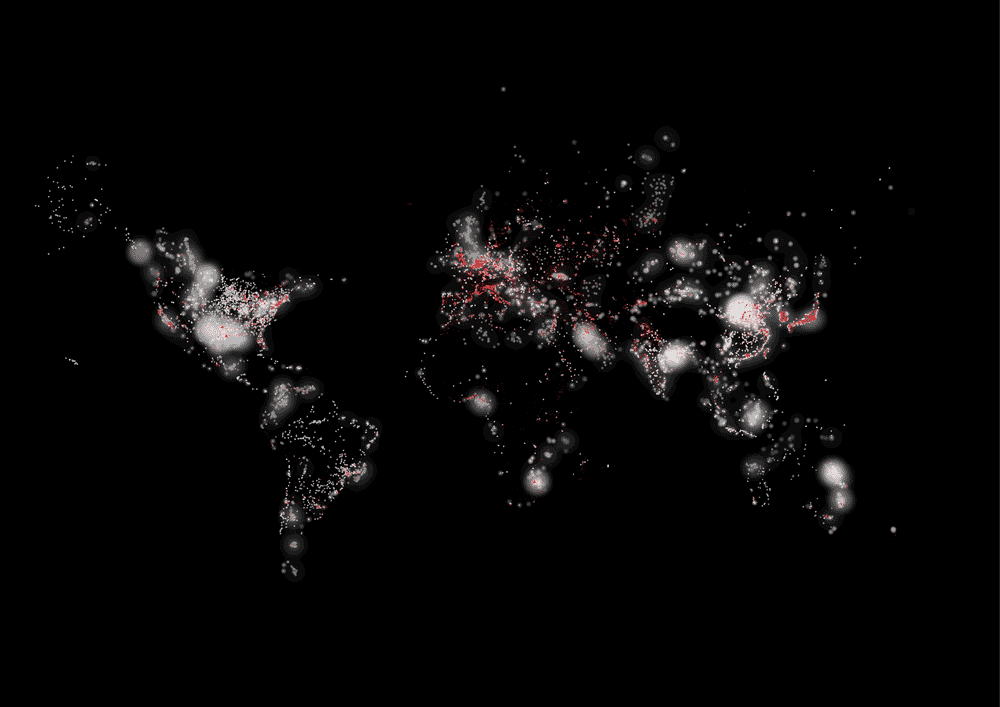
At this moment, the theory of ‘planetary urbanisation’ makes the case that, by the beginning of the 21st century, almost all the human occupation of Earth is shaped by globalised, capitalist urbanisation processes. (Katsikis, 2018) Aiming back at our focus, landscapes of energy, which intrinsically cross operational and agglomeration zones, are central to the feedback loop of development since its rise in EROI made possible the industrialisation of the planet in a relatively sparse configuration. The map below reveals the agglomeration zones (also understood as energy landscapes of consumption) together with the current landscapes of extraction and conversion of energy. These are the operational landscapes of energy, which sum to the extensive productive land of agriculture, grazing, forestry and transportation networks (which could also be considered energy landscapes of distribution).
This forms the material basis for the globalised network and its waves of capitalist intensification that exploit natural systems’ geological work (in short and long temporalities). The before mentioned local biosphere degradation and global climate change are part of the loop that feeds itself by exploitation, then scarcity, then new frontier for capital intensification and nourishing business opportunities as it shares the entropies of its operation in imaginaries that are captured, in for example images like the Blue Marble, and a narrative of humankind inhabiting a shared a global village with its humans in control of a “garden” where everything is open to consumption. At its best, it gave legitimacy to the operationalisation over nature in society, and now its logics of accumulation and scarcity are increasingly becoming palpable as a threat.
Energy transition and the project of mitigation
“Anticipation” is the investigation of the spatial configuration of the “energy transition” under the brief organised by “sustainable development”. It focuses on the energy mode of the renewables and its contribution to mitigating the climatic inheritances of the previous mode of energy, backing up a pace of development for some centuries.
The methodology follows the same pattern as the previous section. With the European Green Deal as policy and the IPCC reports as technical limits, it is possible to anticipate the spatial effects of the decarbonisation of many industries and the scaling-up of renewable energy landscapes. The spatial challenge of renewable energy not only requires more space but also exploits other areas, especially in the energy landscapes of conversion. (IPCC, 2012) As the energy sector is set to “cannibalise” other landscapes, it must receive a comprehensive analysis of its territorial consequences in its search for cheap natures to exploit. By 2050, the “energy transition” will demand a reevaluation of its spatial project.
“Anticipation” visualises the limitations of the brief and anticipates near-future conditions.
1.
“The current epoch is one of accumulation: not only of capital (primitive or otherwise) but also of raw, often unruly material; from plastic in the ocean and carbon in the atmosphere to people, buildings and cities. Of anxiety, and of a recognition of the difficulty of finding effective means for intervening in the behaviors and practices that engender these patterns.” (Nick Axel et al, 2019)
World of sustainable development

Image: First image that appears in Google on “energy transition”
The world of sustainable development as a base for spatial projects is a widely accepted framework. The world of sustainable development will still lead to new possibilities of growth, which under the neoliberal globalisation ends up amplifying current inequalities even if it meets environmental goals, as has been already mentioned before. (Soja, 2009; Marcuse, 2006) Moreover, the European Green Deal sees Europe as a leader. This is questionable in light of history and how European “leadership” started the planetary exploitation of Natures. In these conditions, the EU is set to export its externalities; using energy again as means for renovated domineering in the midst of local environmentally clean practices. It is also worth mentioning that the impact of centuries of colonisation cannot be exported or diluted in discourses on individual ethical positions; in a sense, putting forward the sense that “everyone” should play their part and bear with the consequences of climate change when it is not obviously equally caused and its consequences are also not the same everywhere. Taking the responsibility away from the territory that historically is one of the most responsible for the overstepping of planetary boundaries.
The “sustainability” narrative around the energy topic focuses on policies of decarbonisation, clean air and net-zero energy, transforming ecological crisis into a market opportunity. Since its appearance around the 1960s, sustainability has not done much for the environment it aims to protect and it will possibly be able to mitigate but not to avoid the inauguration of unprecedented climatic instability in the decades to come.
“Not being able to put yourself in the middle is a big problem for ecological thinking.”
(Morton, 2018)
Energy-Ecology
“Projection” is a proposition of the “Energy-Ecology” concept in the landscapes proposed by the findings and assumptions of the “Inheritance” and “Anticipation” sections. It designs with the previous era’s externalities, entropies and accumulations by using it in its favour or addressing its change.
The design workflow is done in three actions: Cartography, Deconstruction and Terraforming as means to model the elements, layers, relations and processes to be continued, interrupted or made new in the compositions and configurations of the operational landscapes of renewable energy production. First, the vertical approach of the overlay provides the infrastructural elements that compose an “Energy-Ecology Network” for the Rhine basin, part of a Trans-European Network, here called “Energy-Ecology Network”. These corridors are decomposed into regions with proposed balances of industrial and biological activities. At last, “territorial typologies” speculate the terraforming of new energetic scale-up.
Energy-ecology is a constructive process to redesign the relation between energy landscapes and ecological considerations in the Rhine basin’s actual landscapes, proposing new urbanisation paradigms. One of its main goals is to connect biodiversity zones by understanding the temporalities and technologies of the infrastructural spaces of energy. It is a design that builds an unbuilt space for biodiversity habitats in the ongoing transition of intertwined energy technologies and the political, economic, societal and ecological framework. The methodology that analysed the inheritance of the globalisation and anticipated the short-term effects of sustainable development can perform a grounded speculation on the long-term frameworks needed for a renewed sense of terraforming, ensuring that Earth remains capable of supporting Earth-like life. This design proposes new balances of industry and biodiversity in frameworks of coexistence that can support the regeneration of ecosystems during the upscaling of renewable energy production landscapes. At the same time, it relies on technologies and focuses on structures that have to do with reorganising an existing relational system.
“Projection” proposes an alternative way of understanding territorial and regional integration with trans-scalar infrastructural landscape design and management proposals for the future operational landscapes of Europe.
“There is no way to build a world that will not be highly technological and there is no way to build a viable technological framework that is not socially sustainable.” (Bratton, 2021)
World as the planetary

Image: Black hole image taken from the project Event Horizon Telescope
2019
In the same way, the other sections had their cosmology; this one can be represented by the composed image of the black hole. It is not an apocalyptical or an image to cause despair. Unlike the Blue Marble, the black hole image was not taken by a human from outer space in a position of “overview”. It was composed by collecting data from many telescopes across various continents on Earth for several hours and assembled by many groups of scientists. It is a picture of Earth, looking at its surroundings. It must be understood with the same effect as the announcing of Copernicus that the Sun did not move around the Earth. This time, it is announcing a Copernican turn of a different sort, rendering humans as enablers, as mediators of a planetary intelligence.
What is its effect on urbanisation? What kind of urban is the planetary? As the project’s narrative has demonstrated, the inherited infrastructures are already placed and connected - only to increase and become more efficient. This is the condition, so how might we conceive and enact a planetarity (as a way of looking to the planet) that undergirds more just future modes of energy? The direction is not a return to pre-urban paradigms but to build new ones with more industrial and biological actions to link our inhabitation modes with the planetary intelligence. To design energy is to design our organisation and possibilities, and crucially how humans treat Earth with its entities.
However, linking back to the essay from Patricia Reed mentioned in the beginning, it is still an “unconcretised existential condition” that could build pathways to inaugurate a new condition. Indeed, this does not bypass social structures because “there is no way to build a world that will not be highly technological, and there is no way to build a viable technological framework that is not socially sustainable.” (Bratton, 2021) It is vital to design platforms that allow other realities, cosmologies and ways of being to coexist. For next energy modes and otherworlds; energy must be seen as an ecology, a new “Energy-Ecology”.